Embroidery accessories
Showing the single result

The embroidery equipment that determines the final result
A botched cross-stitch is rarely down to the pattern chosen. It’s down to the needle used, a poorly tensioned hoop, or scissors that crush the thread instead of cutting it cleanly. Embroidery accessories are not a secondary purchase: they are the tools that determine the evenness of your stitches, the tension of your fabric and, ultimately, the clarity of the finished design.
This category brings together the essentials: tapestry and cross-stitch needles, precision scissors, hoops, embroidery frames, cases and thread organisers. All these items deserve careful consideration, whether you’re starting out with a children’s kit or working on a large canvas.
Embroidery needles: understanding the numbering system before you buy
The needle numbering system is reversed: the higher the number, the finer the needle. A No. 18 needle (heavy gauge, wide eye) is suitable for tapestry wool on 10/10 or 14/10 canvas. A No. 24 or No. 26 needle, with a blunt tip, is used for cross-stitch on Aida fabric with 18 or 28 threads per cm. Mixing the two gives poor results: an eye that is too narrow loosens the thread, whilst an eye that is too wide leaves visible holes in the fabric.
Pointed-tip needles are also used in embroidery (needle embroidery, smocking) but they have no place on a standard cross-stitch chart. If you’re unsure which needle to use, start with the fabric: look at the grid on your canvas, count the threads per centimetre, and choose the corresponding needle size.
Embroidery hoops and frames: maintaining tension without distorting the fabric
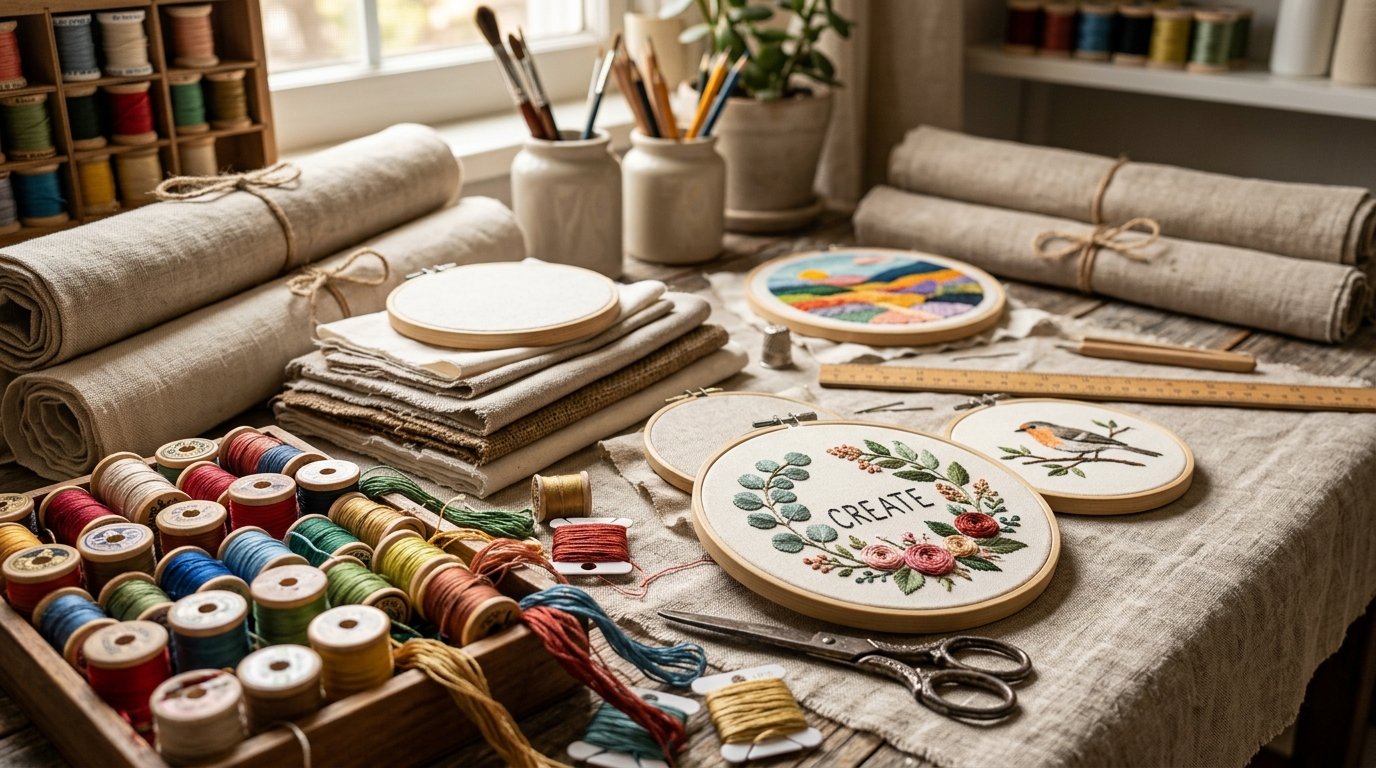
A screw-type embroidery hoop (also known as a frame) keeps the fabric taut whilst you work. Wooden models are the most common, with diameters ranging from 10 to 30 cm. Please note: cheap plastic hoops slip under the tension of the thread and loosen the fabric every ten minutes. A beechwood model with metal screws costs between 4 and 12 euros depending on the diameter, and maintains tension without any extra effort.
For large formats, rectangular frames (slatted or roller frames) are preferable. They prevent the circular marks left by a hoop on delicate fabric left in place for several hours. If you’re working on pre-printed embroidery cushions or large pieces of tapestry, a 30×40 cm wooden slatted frame is a good place to start.
Embroidery scissors: a fine blade, a precise tip
Standard embroidery scissors measure between 9 and 12 cm. The fine blade allows you to cut a taut thread without touching the adjacent fabric. Scissors with curved tips (known as ‘nail’ or ‘embroidery’ scissors) make it easier to cut close to the fabric, which is useful for removing a stitch without risking a hole in the fabric. German brands such as Fiskars, Dovo and Premax have dominated this sector since the 1970s with their well-hardened stainless steel blades. Avoid standard sewing scissors measuring 15 cm or more: they lack precision when working on small areas.
Organising your threads: what beginners overlook
A thread organiser (perforated card or compartmentalised box) is not a luxury. DMC embroidery floss, sold in 8-metre skeins, gets tangled if stored loose in a box. The standard solution: cut 50 cm lengths, thread them through the holes in a numbered card, and note down the colour reference. This method takes five minutes to set up and saves dozens of minutes of untangling. Embroidery accessories often include this type of storage, designed for thicker wool threads.
What you’ll need before you start
- A needle suitable for the fabric: No. 22–24 for Aida 14, No. 18–20 for wool canvas, No. 24–26 for fine linen
- Embroidery hoop or frame depending on the size of the piece (hoop for sizes up to 20×20 cm, frame for all other sizes)
- 10–12 cm embroidery scissors with a fine blade, used exclusively for this purpose
Embroidered items and decorations sometimes require specific accessories, such as beading needles or small frames suitable for rigid surfaces. If you’re just starting out or introducing a child to the craft, the essentials boil down to three things: a good needle, a sturdy wooden embroidery hoop, and scissors that actually cut.